
By Kage Team | 22 June 2026
Reviewed by the Gastroenterology Team, KIMS KAGE — KIMS Hospitals, Secunderabad
Difficulty swallowing is easy to dismiss. We tell ourselves it's stress. We take an antacid. We eat slower. And when it keeps happening, we assume it's just GERD — acid reflux acting up.
But there's a condition called achalasia that causes persistent swallowing difficulty, has nothing to do with acid levels, and doesn't respond to acid-suppression medication — because the problem is entirely mechanical.
It's not common, but it's far more often than it should be: undiagnosed for years.
The Anatomy Behind the Problem
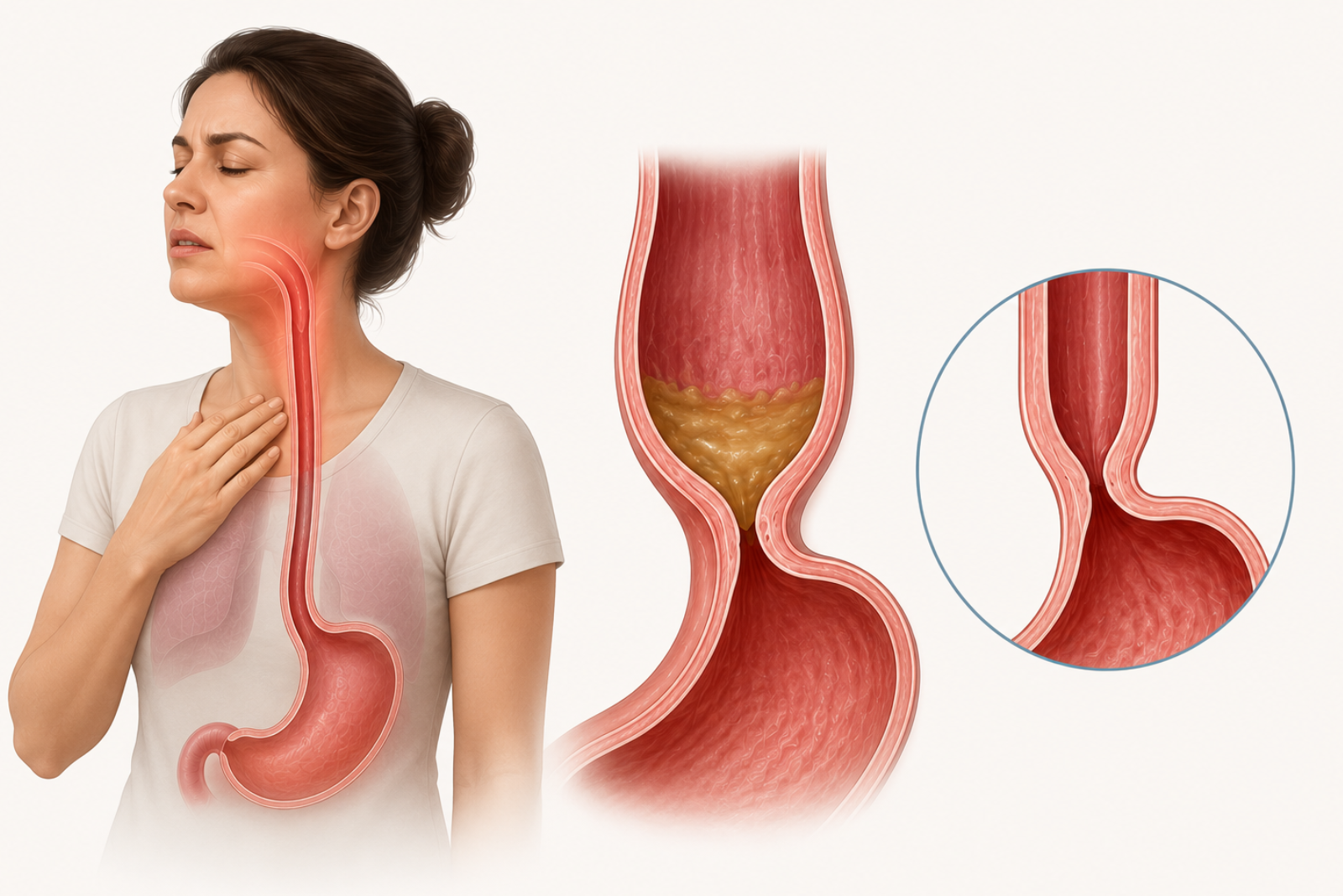
The food pipe (esophagus) is a muscular tube that moves food from your mouth to your stomach through a series of coordinated muscle contractions. At the bottom of the esophagus, there's a valve — the lower esophageal sphincter — that stays closed most of the time to prevent stomach contents from flowing back up. When you swallow, it relaxes and opens to let food pass.
In achalasia, the nerve cells that control this valve stop working properly. The valve doesn't relax when you swallow. The muscles of the food pipe lose their normal rhythm. Food and liquid accumulate in the esophagus instead of moving into the stomach.
Over time, the esophagus stretches and dilates as food pools inside it. This is what creates the hallmark image seen on X-rays — a greatly dilated food pipe that narrows at the bottom like a bird's beak.
Who Gets Achalasia?
Achalasia can affect people of any age, though it's most commonly diagnosed between the ages of 25 and 60. It affects men and women equally. There's no strong hereditary link, and in most cases the exact cause remains unknown.
Research suggests that an autoimmune process — where the body's immune system attacks the nerve cells in the esophagus — may trigger the condition, possibly set off by a viral infection. But this is still being studied.
Symptoms — and Why They Get Confused With GERD
The most distinctive symptom is dysphagia — difficulty swallowing. Unlike typical GERD, where the problem is mainly with solid foods (because acid irritates the lining), achalasia affects swallowing of both solids and liquids. Often equally.
Other symptoms include:
- Regurgitation of undigested food or liquid — sometimes hours after eating
- Chest pain or a heavy pressure behind the breastbone during meals
- Waking up in the night because food or liquid has come back up
- Recurring chest infections from food particles entering the lungs
- Gradual, unintentional weight loss from eating less to avoid symptoms
- Difficulty belching — trapped air that can't be released normally
The heartburn that many achalasia patients experience leads to an immediate assumption of GERD. Proton pump inhibitors are prescribed, symptoms don't improve, and the patient is left cycling through medications for a problem that has nothing to do with acid.
The Risk of Staying Undiagnosed
Achalasia is a progressive condition. Without treatment, the esophagus stretches further and further over time. Breathing in food particles from regurgitation can cause recurrent pneumonia. Malnutrition becomes a risk as patients eat less and less.
There is also a small but real increase in the risk of esophageal cancer in longstanding, untreated achalasia — particularly a type called squamous cell carcinoma. This risk is significantly reduced with appropriate treatment.
Getting the Right Diagnosis
If standard reflux treatment isn't working and you have consistent swallowing difficulty, the next step should be a referral to a gastroenterologist for proper diagnostic workup.
The two key tests are high-resolution manometry — a pressure measurement of the esophagus that gives a definitive diagnosis — and a barium swallow X-ray, which shows the structural changes in the food pipe. An upper GI endoscopy is also done to rule out other causes.
A normal-appearing endoscopy does not rule out achalasia. Many patients are falsely reassured by a 'normal' endoscopy report because the specialist wasn't specifically looking for or testing manometric function.
What Treatment Actually Looks Like
The goal of treatment is to weaken the lower esophageal sphincter so food can pass through more easily. There is no treatment that reverses the nerve damage itself.
Options range from botulinum toxin injections (temporary, good for patients who aren't candidates for more invasive treatment) to pneumatic dilation (balloon stretching of the sphincter) to surgical or endoscopic myotomy — cutting the sphincter muscles.
The most advanced option available is the POEM procedure (Peroral Endoscopic Myotomy) — an endoscopic approach that cuts the sphincter from inside the esophageal wall, with no external incisions. It has among the highest long-term success rates of any achalasia treatment.
For a detailed explanation of how POEM works, read our guide: POEM Procedure for Achalasia — What It Is, How It Works, and What to Expect.
When to Come to KIMS KAGE
If you or someone you know has been dealing with swallowing difficulty for more than a few weeks — especially if:
- Antacids and PPIs haven't helped
- Food feels like it's getting stuck in the chest
- You've been waking up from sleep due to regurgitation
- You've had unexplained weight loss
it's time for a proper gastroenterological evaluation, not another round of trial-and-error medication.
At KIMS KAGE, Secunderabad, the gastroenterology team performs advanced diagnostics including high-resolution manometry and offers the full range of achalasia treatments including POEM.
Book a consultation at KIMS KAGE, KIMS Hospitals, Secunderabad — call +91-7288842255 or visit kimskage.com.
Frequently Asked Questions
It's a chronic condition that worsens progressively without treatment. With the right treatment, most patients experience significant improvement in quality of life and can eat normally. Untreated, it carries risks of malnutrition, lung complications, and a small increased risk of esophageal cancer.
Achalasia is rare globally — affecting about 1 in 100,000 people — but it's underdiagnosed in India due to limited access to manometry testing and a tendency to attribute all swallowing or chest symptoms to GERD.
Not necessarily open surgery. The POEM procedure is endoscopic — done entirely through the mouth with no skin incisions. It's now the preferred approach for most eligible patients and offers high rates of long-term improvement.
There is no cure in the sense of reversing the nerve damage. But treatment can relieve symptoms effectively and durably in most patients. POEM and surgical myotomy have the best long-term outcomes.