
By Kage Team | 26 May 2026
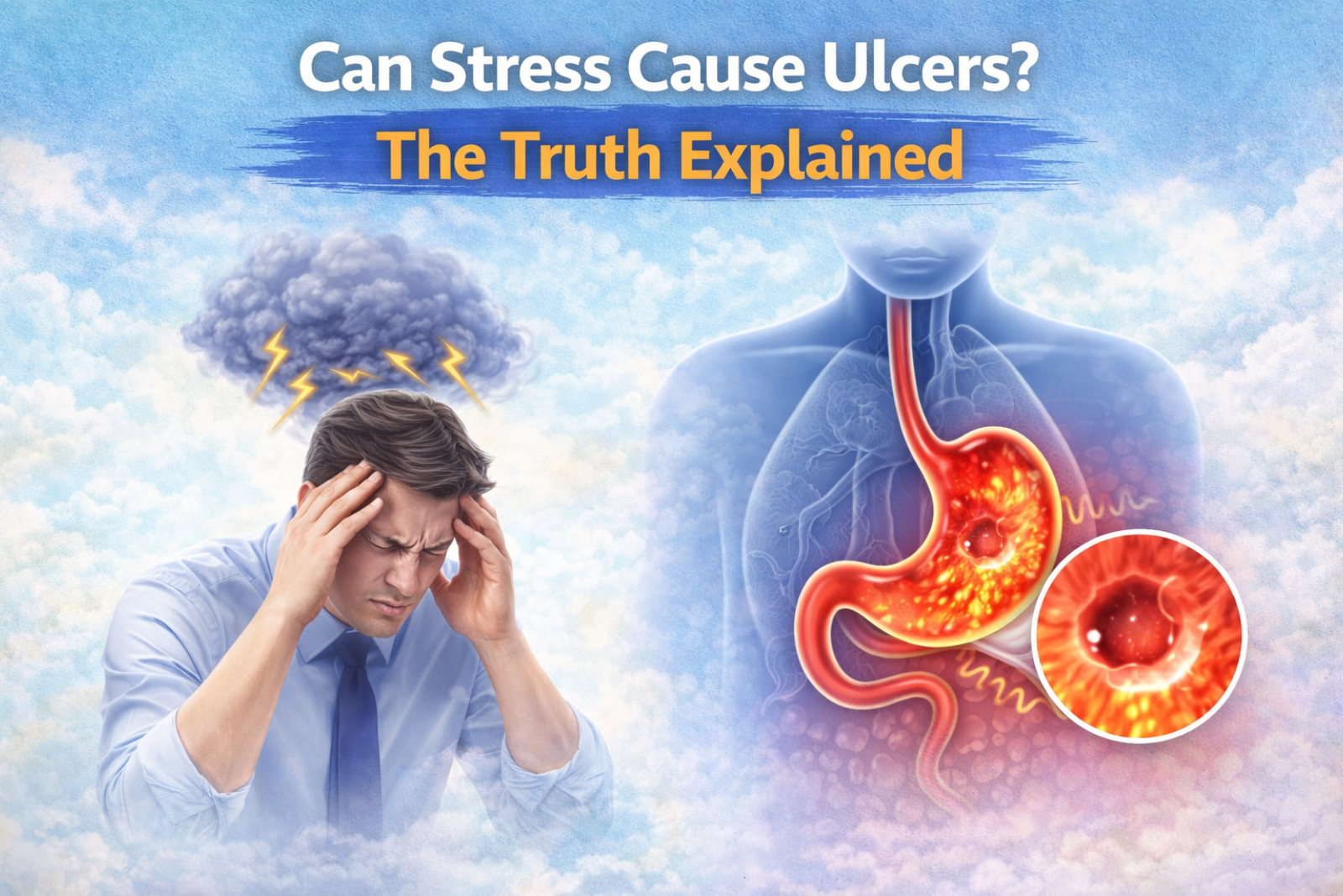
"You worry too much — that's why you have stomach problems." In India, where family pressures, professional demands, and the sheer intensity of urban life create a chronic stress state for millions of people, this explanation for stomach ulcers is given constantly — by doctors, family members, and patients themselves.
The relationship between stress and stomach ulcers is real, nuanced, and widely misunderstood. The truth lies somewhere between "stress is the main cause of ulcers" (an older belief now known to be incorrect) and "stress has nothing to do with ulcers" (also wrong).
At KIMS Advanced Gastroenterology & Endoscopy — KAGE — KAGE, KIMS Hospitals, Secunderabad, Secunderabad, Dr. Sreekanth Appasani and our specialist team regularly evaluate patients whose digestive symptoms — including ulcers — are significantly influenced by their stress levels, even if stress was not the original cause. This blog provides the evidence-based truth about stress and stomach ulcers.
The Old Belief: Stress Causes Ulcers
For decades — until the 1980s — stomach ulcers were believed to be caused primarily by stress and dietary factors. The stereotypical ulcer patient was the hard-driven, anxious executive, constantly worried. Stress management and bland diets were the primary treatments. Then, in 1983, Australian physicians Barry Marshall and Robin Warren discovered Helicobacter pylori — the bacterial cause of most peptic ulcers — a discovery for which they won the Nobel Prize in 2005. This fundamentally changed ulcer medicine.
The Current Evidence: What Stress Actually Does
Stress Does NOT Directly Create Ulcers
Psychological stress does not directly produce a peptic ulcer in a person with a healthy stomach lining and no H. pylori infection. The vast majority of peptic ulcers are caused by H. pylori bacteria or NSAIDs — not by psychological stress.
Stress DOES Play a Role in Ulcer Disease — In Several Important Ways
- Worsening existing disease: Stress significantly worsens symptoms, slows healing, and increases pain sensitivity in patients who already have an H. pylori infection or NSAID-damaged stomach lining.
- Promoting ulcerogenic behaviors: Stressed people drink more alcohol, smoke more, use NSAIDs more for tension headaches and body pain, sleep less, and eat irregularly — all of which increase ulcer risk.
- Cortisol and mucosal defence: Chronic stress elevates cortisol, which reduces the stomach's prostaglandin production — weakening the mucosal protective barrier and making the stomach more vulnerable to acid injury.
- Increasing acid secretion: Acute psychological stress increases gastric acid output — particularly relevant in a stomach already inflamed by H. pylori.
- Impairing ulcer healing: Even after appropriate medical treatment begins, ongoing chronic stress delays mucosal repair by reducing mucosal blood flow and growth factor production.
Stress Ulcers — A Real but Different Entity
'Stress ulcers' (stress-related mucosal disease) do exist — but they refer specifically to acute mucosal erosions developing in critically ill patients in intensive care units, not to the chronic peptic ulcers of outpatients. These stress ulcers are caused by physiological stress (shock, burns, major trauma, respiratory failure) — not psychological stress — and are prevented with routine PPI prophylaxis in ICUs at KIMS Hospitals.
The Gut-Brain Axis: Why Stress 'Feels' Like an Ulcer
Psychological stress activates the hypothalamic-pituitary-adrenal (HPA) axis and the autonomic nervous system — both of which directly affect gut function. Stress increases visceral hypersensitivity — the gut's nervous system becomes more reactive, so normal amounts of acid or gut movement are experienced as pain. This is why patients with functional dyspepsia (no structural ulcer) and IBS experience symptoms that feel exactly like an ulcer during periods of high stress. The pain is real — but its origin is functional, not structural.
What This Means for Hyderabad Patients
In Hyderabad's high-stress urban environment — where IT deadlines, traffic, family obligations, and financial pressures create a chronic stress state — the gut-brain axis is constantly activated. This means:
- Stress management is genuinely important for GI health — not as a substitute for medical diagnosis, but as a complementary strategy
- H. pylori testing and endoscopy are still essential — you cannot diagnose an ulcer or exclude one based on stress history alone
- The combination of H. pylori infection plus chronic stress is particularly damaging — treat both
- Yoga, pranayama, adequate sleep, and reducing alcohol use during high-stress periods are evidence-backed GI health interventions for Hyderabad's population
When to See a Gastroenterologist
If you have stomach symptoms that worsen with stress — whether they represent true ulcer disease, H. pylori gastritis, functional dyspepsia, or IBS — you deserve accurate diagnosis, not just the advice to "reduce stress." At KAGE, KIMS Hospitals, Secunderabad, Secunderabad, Dr. Sreekanth Appasani and our team investigate, diagnose, and treat the structural and functional components of stress-related GI symptoms precisely.
Conclusion
Stress affecting your stomach? Get properly evaluated at KAGE, KIMS Hospitals, Secunderabad. Call: +91-7288842255
Frequently Asked Questions
Psychological stress activates the gut-brain axis, increasing visceral hypersensitivity — the gut becomes more reactive and pain-sensitive. Normal acid and gut movements that would not cause pain in a relaxed state are experienced as painful when you are stressed. This explains stress-related GI symptoms without an underlying structural ulcer. However, it does not exclude an ulcer — investigation is still needed.
Stress management is a valuable adjunct to medical ulcer treatment — not a substitute. Yoga, pranayama, adequate sleep (7–9 hours), mindfulness, and exercise reduce cortisol levels, lower gastric acid secretion, improve mucosal blood flow, and reduce pain sensitivity. Combined with H. pylori eradication and PPI therapy, stress management accelerates ulcer healing and reduces recurrence.
Yes — anxiety disorder is strongly associated with functional dyspepsia and IBS, both of which produce upper abdominal pain, nausea, early satiety, and bloating that can be indistinguishable from ulcer symptoms on clinical history alone. Low-dose antidepressants (amitriptyline, SSRIs) reduce gut hypersensitivity in these conditions. However, anxiety disorder does not exclude structural pathology — endoscopy is needed to differentiate functional from organic disease.
The gut-brain axis is the bidirectional neural, hormonal, and immune communication network between the central nervous system (brain) and the enteric nervous system (gut's own nervous system). Stress activates this axis — increasing gut sensitivity, altering motility, reducing mucosal blood flow, and elevating acid secretion. While these effects do not create ulcers de novo, they powerfully amplify the effects of H. pylori and NSAIDs on the stomach lining.
KIMS Advanced Gastroenterology & Endoscopy — KAGE — KAGE, C/O Gastroenterology Dept, KIMS Hospitals, 1-8-31/1, Minister Road, Secunderabad, Hyderabad – 500003. Open Monday to Saturday, 9:00 AM to 5:30 PM. Call +91-7288842255 or email appointments.kage@gmail.com.