
By Kage Team | 26 May 2026
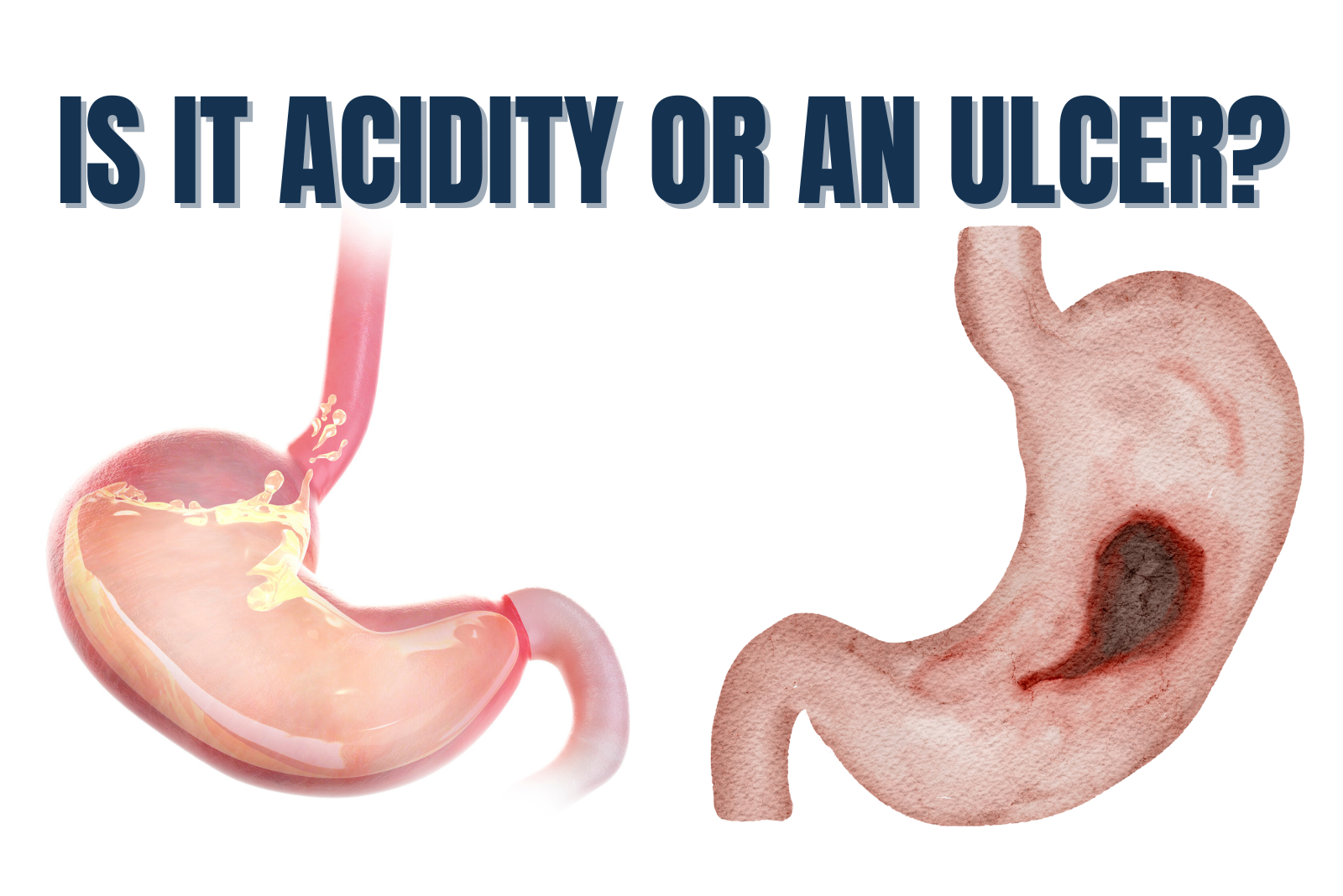
In India, the word "acidity" is used almost universally for any stomach or upper abdominal discomfort — heartburn, indigestion, bloating, stomach pain, and yes, ulcer pain are all commonly referred to as "acidity." This linguistic habit has a dangerous consequence: it normalizes and delays the diagnosis of peptic ulcer disease, allowing ulcers to progress toward complications while patients continue reaching for antacids.
Understanding the difference between simple acidity (including GERD and functional dyspepsia) and a stomach ulcer is one of the most clinically important distinctions in GI medicine — and at KIMS Advanced Gastroenterology & Endoscopy — KAGE — KAGE, KIMS Hospitals, Secunderabad, Secunderabad, Dr. Sreekanth Appasani and our specialist team help patients make this distinction accurately every day.
What Is Acidity (In the Colloquial Indian Sense)?
When Indians say 'acidity', they typically mean one of three things: GERD (heartburn from acid reflux into the esophagus), Functional Dyspepsia (upper abdominal discomfort without a structural cause — the most common GI diagnosis worldwide), or Gastritis (inflammation of the stomach lining — typically from H. pylori or NSAIDs).
What Is a Stomach Ulcer?
A peptic ulcer is a discrete mucosal break — an open wound — in the stomach or duodenal lining, at least 5mm in depth, caused by the combination of acid exposure and mucosal defense failure. It is a structural lesion, not just a functional symptom.
Key Differences Between Acidity and an Ulcer
Pain Character
- Acidity/GERD: Burning behind the breastbone (retrosternal); may rise toward the throat; often worsened by lying down or bending over.
- Stomach ulcer: Burning or gnawing pain in the upper middle abdomen (epigastrium); deeper quality; may radiate to the back.
Relationship to Food
- GERD: Worse after meals and when lying down; worsened by spicy, fatty food; may improve when upright.
- Gastric ulcer: Pain worsens 30–60 minutes after eating.
- Duodenal ulcer: Pain improves immediately after eating — then returns 2–3 hours later on an empty stomach; classic nocturnal pain.
Response to Antacids
- Simple acidity: Responds well to antacids — relief is complete and sustained.
- Stomach ulcer: Antacids provide partial, temporary relief — pain returns. Repeated antacid use without improvement is a red flag.
Associated Symptoms
- Simple acidity: Typically no alarming associated symptoms — no weight loss, no bleeding, no dysphagia.
- Stomach ulcer: May be associated with weight loss (from food avoidance), anaemia (from chronic slow bleeding), nausea, and in complicated cases — vomiting blood or black stools.
Duration and Pattern
- Simple acidity: Episodic — triggered by specific foods, stress, or positional changes.
- Stomach ulcer: Cyclical pattern with pain-free periods — characteristic of peptic ulcers. May persist for weeks, resolve, then return.
Red Flags That Point Toward an Ulcer Rather Than Acidity
If any of these red flags are present alongside your 'acidity', do not assume it is routine. Book an endoscopy at KAGE for accurate diagnosis.
- Symptoms persisting despite 2+ weeks of antacids or PPIs
- Nocturnal pain waking you from sleep
- Unexplained weight loss
- Any blood in stool — black/tarry or bright red
- Anaemia identified on blood tests
- Family history of stomach ulcer or gastric cancer
- Regular NSAID or aspirin use
When to Stop Managing 'Acidity' at Home and See a Specialist
- Symptoms have persisted for more than 4 weeks without adequate response
- You are over 45 with new-onset upper GI symptoms
- Alarm features are present
- You are a regular NSAID user with stomach symptoms
- Your acidity pattern has changed from what it used to be
Conclusion
Chronic 'acidity' that antacids don't fix? Get properly diagnosed at KAGE, KIMS Hospitals, Secunderabad. Call: +91-7288842255
Frequently Asked Questions
Yes — this is precisely why so many ulcers go undiagnosed for extended periods. The burning quality, the relationship to meals, and the improvement with antacids can all be shared by acidity and peptic ulcers. The distinguishing features — nocturnal pain, weight loss, anaemia, inadequate antacid response, and alarm features — are the clinical signals that distinguish them, along with endoscopy.
If symptoms resolve within 2 weeks on antacids and do not recur, investigation may not be immediately necessary. If symptoms persist despite 2 weeks of antacids, keep recurring, are worsening, or are accompanied by any alarm feature — investigation with endoscopy at KAGE is warranted. Do not continue self-medicating for months with worsening symptoms.
PPIs and antacids are commonly prescribed for upper GI symptoms before the specific cause is identified — this is appropriate initial management in younger patients without alarm features. However, if symptoms persist despite adequate PPI therapy, the next step is endoscopy to identify whether an ulcer, H. pylori infection, or other pathology is present.
Yes — a patient can have both GERD and a peptic ulcer simultaneously, particularly if they have H. pylori infection (which affects the entire gastric mucosa) or are NSAID users. Endoscopy at KAGE evaluates the entire upper GI tract — esophagus, stomach, and duodenum — in a single procedure, identifying all pathology present.
C/O Gastroenterology Dept, KIMS Hospitals, 1-8-31/1, Minister Road, Secunderabad, Hyderabad – 500003. Open Monday to Saturday, 9:00 AM to 5:30 PM. Call +91-7288842255 or email appointments.kage@gmail.com.