
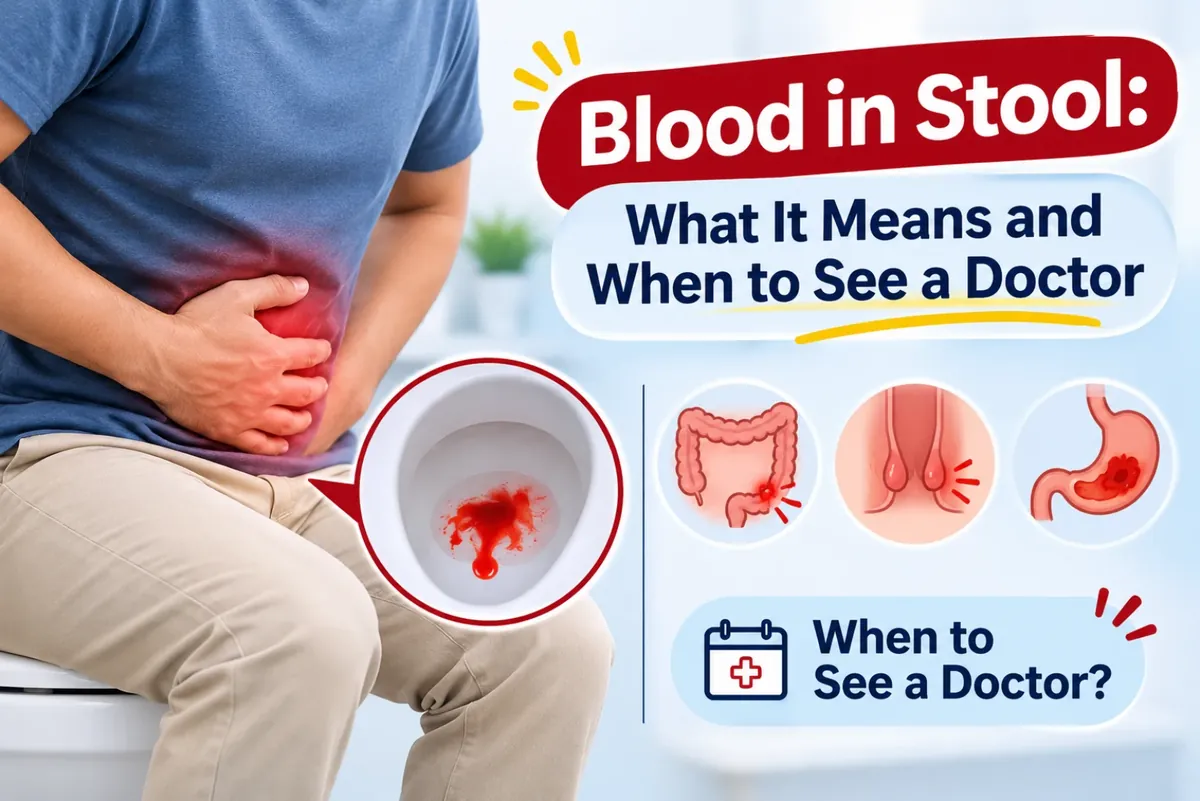
The short answer
Blood in your stool usually comes from something common and treatable, like piles or a small tear near the anus (fissure). It can also come from swelling of the bowel lining, polyps or, less often, a growth. You cannot tell the cause just by looking, so any new bleeding should be checked by a doctor. Go to an emergency department now if the bleeding is heavy or keeps coming, or if you feel faint or dizzy. See a gastroenterologist soon if it keeps coming back, comes with weight loss, tummy pain, tiredness or a change in bowel habit, or if you are 50 or older.
Quick facts
- Most common cause: piles. In a colonoscopy study from Visakhapatnam, about 4 in 10 people with rectal bleeding had piles (Reddy et al., 2024).
- Not always piles: the same study found bowel inflammation (IBD) in about 1 in 8 people and a growth in about 1 in 10.
- Younger people are not exempt: at AIIMS New Delhi, about a third of 970 people treated for bowel cancer were 40 or younger (Deo et al., 2021).
- Main test: colonoscopy. The doctor sees the whole large bowel and can take a sample or treat some causes in the same sitting.
What does the colour of the blood tell you?
The colour gives your doctor a clue about where the bleeding is coming from. It is a clue only. It does not tell you the cause.
| What you see | Where it usually comes from | Common causes |
|---|---|---|
| Bright red blood on the toilet paper or dripping into the toilet, separate from the stool | The anus or the end of the rectum | Piles, anal fissure |
| Red or dark red blood mixed into the stool | The rectum or colon | Colitis, polyps, a growth, diverticular bleeding |
| Blood with mucus, often with loose motions or urgency | Swollen lining of the rectum or colon | Ulcerative colitis, Crohn’s disease, infection |
| Black, sticky, tar-like stool with a strong smell | Higher up: food pipe, stomach or duodenum | Bleeding ulcer, swollen veins (varices). This is urgent |
| Maroon stool or clots, with dizziness | Can be the colon or a fast bleed higher up | Needs emergency care |
Some things look like blood but are not
Beetroot and red food colouring can turn stool red. Iron tablets can make stool dark green or black, but it is not usually sticky or tar-like. If you are not sure, tell your doctor what you ate and which medicines you take. Black, sticky stool is covered in our guide to vomiting blood and black stools.
Common causes of blood in stool
Piles (haemorrhoids)
Piles are swollen blood vessels inside or around the anus. The blood is usually bright red, painless, and seen on the paper or in the toilet after passing a hard stool. Piles are common if you are often constipated, during pregnancy, and if you sit for long hours at work. Read our piles page and our guide on when to stop treating piles at home.
Anal fissure
A fissure is a small cut in the skin at the opening of the anus. It causes sharp pain while passing stool, and the pain can last for a while after. You may see a streak of bright red blood. Most fissures heal with softer stools, more fibre and water, and treatment from your doctor.
Inflammatory bowel disease (IBD)
Ulcerative colitis and Crohn’s disease cause long-term swelling of the bowel lining. The bleeding often comes with mucus, loose motions, urgency, waking at night to pass stool, tummy pain or weight loss. IBD is now seen more often in India. See our IBD Clinic and ulcerative colitis pages.
Bowel infections
Some bacteria and parasites, including amoeba, can cause bloody loose motions with fever and cramps. In India, tuberculosis of the intestine can also cause bleeding, weight loss and a change in bowel habit, and can look like Crohn’s disease. Bloody loose motions with fever need a doctor, not home treatment. See diarrhoea.
Colon polyps
Polyps are small growths on the inside of the colon. Most cause no symptoms, but some bleed. Some types can turn into cancer over several years, so doctors remove them during colonoscopy. See colon polyps.
Diverticular bleeding
Small pouches in the wall of the colon (diverticula) can bleed, sometimes a lot and without pain. This is more common in older people and in people who take blood thinners or painkillers like NSAIDs. See diverticular disease.
Bowel cancer
This is a less common cause. It is the reason doctors do not write off bleeding as “just piles”. Warning signs include blood mixed into the stool, a change in bowel habit that lasts for weeks, weight loss without trying, tiredness from low iron (anaemia), and bowel cancer in a parent, brother or sister. In India, bowel cancer is seen in younger adults more than many people expect. In an AIIMS New Delhi series of 970 patients, about a third were 40 or younger (Deo et al., 2021). Our colorectal screening guide explains screening.
Other causes
Swelling of the rectum after radiotherapy to the pelvis, a single ulcer in the rectum, small fragile blood vessels in the bowel wall, bleeding after a polyp is removed, and ulcers caused by some medicines.
When is blood in stool an emergency?
Go to the nearest hospital emergency department, or call an ambulance, if you have blood in your stool and any of these:
- A lot of blood, large clots, or bleeding that does not stop
- Feeling faint, dizzy or confused, especially when you stand up
- Fast heartbeat, cold or sweaty skin, or breathlessness
- Black, sticky stool, or vomiting blood or something that looks like coffee grounds
- Severe tummy pain, a swollen tummy, or high fever
- You take blood thinners. Do not stop them on your own. Tell the emergency team which ones you take.
Heavy bleeding can come from higher up
Heavy red bleeding with dizziness can sometimes come from the stomach rather than the colon. So the emergency team may need an upper GI endoscopy as well as a colonoscopy (American College of Gastroenterology, 2023).
When should you see a gastroenterologist?
If the bleeding is not heavy, book a visit soon if:
- It keeps coming back, or has gone on for more than a week or two
- The blood is mixed into the stool, not just on the paper
- Your bowel habit has changed for a few weeks: looser, harder, more often, or a feeling of not emptying fully
- You have lost weight without trying, feel very tired, or have been told you have low iron
- You have tummy pain, mucus, or need to pass stool at night
- You are 50 or older and there is no clear reason for the bleeding
- A parent, brother or sister has had bowel cancer or many colon polyps
- You were treated for piles and the bleeding has not stopped
Where these points come from
These points follow UK NICE guidance. NICE advises an urgent check for adults aged 50 and over with unexplained bleeding from the back passage. It also advises an urgent check for adults under 50 whose bleeding comes with tummy pain, a change in bowel habit, weight loss or low iron (NICE NG12).
What happens at the appointment?
Your doctor will ask about the colour and amount of blood, how often it happens, your bowel habit, weight, food, medicines and family history. A gentle check of the back passage is usually part of the first visit, because many causes are within easy reach.
Read more about colonoscopy, including preparation and risks, and about capsule endoscopy.
| Test | What it is | Why it is done |
|---|---|---|
| Blood tests | A sample from your arm | To check for low iron, anaemia, swelling and infection |
| Stool tests | A small stool sample | To look for infection, hidden blood or bowel swelling |
| Proctoscopy | A short tube a few centimetres into the anus, in the clinic | To see piles and fissures |
| Sigmoidoscopy | A thin camera looks at the rectum and lower colon | For bleeding that likely comes from the lower bowel |
| Colonoscopy | A thin camera looks at the whole large bowel, usually under sedation, after a bowel clean-out the day before | To find the cause, take samples, remove polyps and treat some bleeding in the same sitting |
| Upper GI endoscopy | A camera through the mouth to the stomach | If the stool is black or the bleeding may be from higher up |
| Capsule endoscopy or CT scan | A pill-sized camera you swallow, or a contrast CT scan | If the cause is not found on endoscopy and colonoscopy |
Why you should not keep treating it as piles at home
Many people treat bleeding as piles for months, with creams, home remedies or advice from friends. Piles are the most common cause, but colitis, polyps and growths can bleed in the same way. And you can have piles and another cause at the same time. A short check tells your doctor if piles explain the bleeding, or if you need a colonoscopy.
Blood in stool in children
In children, common causes are fissures from constipation, cow’s milk allergy in babies, infections and polyps. Get urgent care if a child loses a lot of blood, looks pale or sleepy, has a swollen tummy, vomits green fluid, or passes blood that looks like red jelly. For bleeding that keeps coming back, see our pediatric gastroenterology team.
Getting checked for blood in stool in Hyderabad
KAGE (KIMS Advanced Gastroenterology & Endoscopy) is the gastroenterology department at KIMS Hospitals, Secunderabad. The department offers outpatient consultation, colonoscopy, upper GI endoscopy, capsule endoscopy and pediatric gastroenterology.
KAGE, KIMS Hospitals Secunderabad
- Address: Gastroenterology Department, KIMS Hospitals, 1-8-31/1, Minister Road, Krishna Nagar Colony, Ramgopalpet, Begumpet, Secunderabad, Hyderabad, Telangana 500003
- Phone: +91-7288842255
- Doctors: see the KAGE consultant team on the doctors page
- Directions and timings: Secunderabad location page
Coming from outside Hyderabad
People travel to KAGE from other parts of Telangana, such as Karimnagar, Warangal, Nalgonda, Nizamabad and Mahbubnagar, and from Andhra Pradesh cities such as Vijayawada, Guntur and Visakhapatnam. Bring your old reports, scan images and a list of your medicines. Ask when you call whether a colonoscopy could be done on the same trip, because it needs a bowel clean-out the day before. Our guide for patients from outside Hyderabad helps you plan the trip. Contact the hospital for service information through the contact page. Ask your doctor about suitable treatment options for your situation.
- Vomiting Blood and Black Stools
Type: Blog
- Piles (Hemorrhoids)
Type: Treatment
- When to Stop Treating Piles at Home
Type: Blog
- IBD Clinic
Type: Speciality Clinic
- Ulcerative Colitis
Type: Speciality Clinic
- Diarrhoea
Type: Treatment
- Colon Polyps
Type: Treatment
- Diverticular Disease
Type: Treatment
- Colorectal Cancer Screening and Colonoscopy in Hyderabad
Type: Blog
- Upper GI Endoscopy
Type: Advanced Procedure
- Colonoscopy
Type: Advanced Procedure
- Capsule Endoscopy
Type: Speciality Clinic
- Pediatric Gastroenterology
Type: Speciality Clinic
- Our Doctors at KAGE Hyderabad
Type: Doctor Profile
- KAGE Secunderabad Location
Type: Location
- Patients from Outside Hyderabad
Type: Patient Guide
- Contact KAGE
Type: Contact
Frequently Asked Questions
No. Most of the time it comes from piles or a fissure, which are common and treatable. But you cannot tell the cause by looking at the blood, so new, repeated or unexplained bleeding should be checked by a doctor.
Go to an emergency department if the bleeding is heavy, you feel faint or dizzy, or your stool is black and sticky. See a gastroenterologist soon if the bleeding keeps coming back, is mixed into the stool, or comes with weight loss, tiredness, tummy pain or a change in bowel habit, or if you are 50 or older.
It is often from internal piles. But polyps and some growths can also bleed without pain, so painless bleeding that keeps coming back still needs an examination.
Blood with mucus usually means the lining of the rectum or colon is inflamed. Common causes are ulcerative colitis, Crohn’s disease and bowel infections. Your doctor may suggest stool tests and a colonoscopy.
A gastroenterologist. They treat problems of the digestive system and do colonoscopy. If you need an operation, for example for large piles, they will send you to a surgeon.
Spicy food can make piles or a fissure sting and feel worse, but it does not cause bleeding on its own. Do not blame food or stress for bleeding without getting checked.
Not always. If a young person with no warning signs has a clear cause such as a fissure, the doctor may treat that first. A colonoscopy is usually advised if you are older, the blood is mixed into the stool, there are warning signs, or the bleeding does not stop after treatment.
KAGE, the gastroenterology department at KIMS Hospitals on Minister Road, Secunderabad, offers consultations and colonoscopy. Phone +91-7288842255 for service information and timings.