
By Kage Team | 16 June 2026
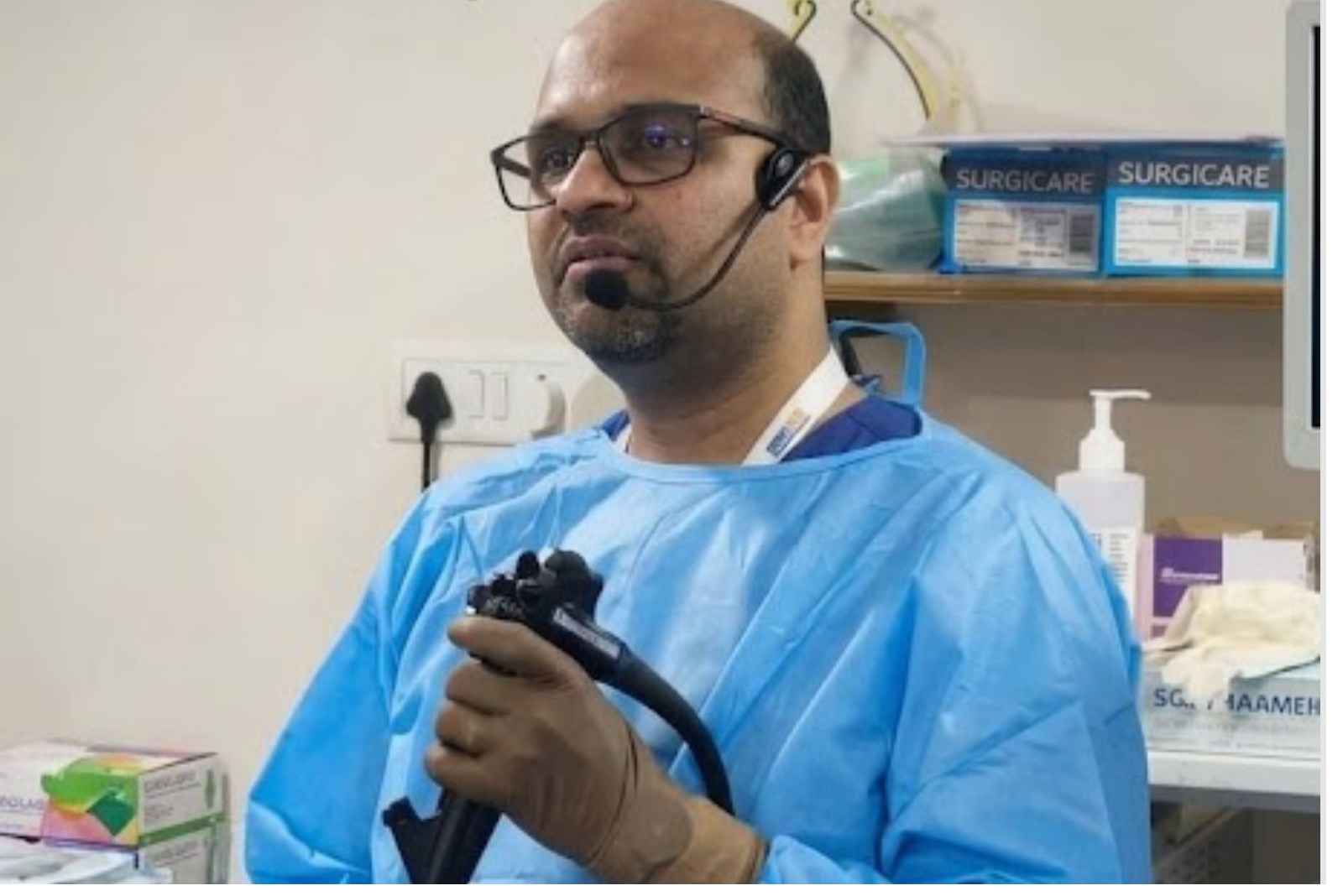
Reviewed by the Gastroenterology Team, KIMS KAGE — KIMS Hospitals, Secunderabad
Imagine sitting down for a meal and finding that swallowing has become a task. Food feels like it's stopping midway, refusing to reach the stomach. Water helps sometimes. Leaning back while eating helps other times. But nothing fully fixes it.
If this sounds familiar, you may be dealing with achalasia — a condition that affects the food pipe (esophagus) and makes swallowing genuinely difficult. The good news is that it has a highly effective, minimally invasive treatment: the POEM procedure.
This blog explains what achalasia actually is, why it gets misdiagnosed as GERD so often, and how POEM works — without jargon.
What Is Achalasia?
Achalasia is a disorder of the esophagus — the muscular tube that carries food from your throat to your stomach. Normally, the lower end of the esophagus has a valve called the lower esophageal sphincter (LES) that relaxes when you swallow, allowing food to pass through.
In achalasia, the nerve cells that control this valve degenerate over time. The sphincter stops relaxing properly, and the muscles of the food pipe lose their normal coordinated movement. The result: food and liquid back up instead of passing into the stomach.
It's a rare condition — affecting roughly 1 in 100,000 people — but it's significantly underdiagnosed in India because its symptoms overlap with far more common conditions.
The Problem With Misdiagnosis
Achalasia is frequently mistaken for GERD (acid reflux), and patients often spend months or years on acid-suppression medication that doesn't help. Here's a key difference: in GERD, the LES is too loose — acid leaks upward. In achalasia, the LES is too tight — nothing passes downward.
Between 27% and 42% of achalasia patients experience heartburn, which further adds to the confusion. The symptom that usually gives it away is food sticking in the chest — not just acid coming up, but food that simply won't go down.
If your GERD medication hasn't worked after a few months, and you're still experiencing difficulty swallowing or food regurgitating hours after eating, ask your gastroenterologist specifically about achalasia.
Symptoms That Point Toward Achalasia
- Difficulty swallowing both solids and liquids (this is important — GERD usually affects solids first)
- Food or liquid coming back up into the mouth, sometimes hours after eating
- Chest pain or pressure during or after meals
- Waking up at night due to regurgitation
- Unintentional weight loss from eating less to avoid symptoms
- Difficulty belching — trapped air that can't escape normally
- Recurrent chest infections from food particles entering the airway
How Is Achalasia Diagnosed?
Diagnosis requires specific tests — a regular endoscopy often appears normal in early achalasia, which is another reason it gets missed.
High-Resolution Manometry (HRM)
This is the gold standard test. A thin tube is passed through the nose and positioned along the esophagus to measure pressure patterns when you swallow. It can detect abnormal contractions and a non-relaxing LES with high accuracy.
Barium Swallow X-ray
You drink a barium solution and X-rays are taken as it travels through the esophagus. In achalasia, the characteristic image is a 'bird beak' or 'rat tail' narrowing at the bottom of the esophagus — a narrowing caused by the tight sphincter.
Upper GI Endoscopy
Primarily done to rule out other causes of swallowing difficulty — tumours, strictures, or ulcers — rather than to diagnose achalasia directly.
Treatment Options for Achalasia
There is no treatment that reverses the nerve damage in achalasia. All treatments work by reducing pressure at the lower esophageal sphincter, making it easier for food to pass through.
Pneumatic Balloon Dilation
An endoscope-guided balloon is positioned at the LES and inflated to forcefully stretch and weaken the sphincter. Effective in many patients, though it may need to be repeated, and there is a small risk of esophageal perforation.
Botulinum Toxin Injection
Botox is injected into the LES via endoscopy to temporarily relax it. Effects last 6 to 12 months and need to be repeated. Best suited for patients who cannot undergo more invasive procedures.
Heller Myotomy
A surgical procedure (laparoscopic) where the sphincter muscles are cut to allow food to pass. Effective, but involves incisions and longer recovery.
POEM — Peroral Endoscopic Myotomy
The most advanced option currently available, and the focus of this blog.
What Is the POEM Procedure?
POEM stands for Peroral Endoscopic Myotomy. 'Peroral' means through the mouth — there are no cuts or incisions in the skin.
Here is what the procedure actually involves:
- The patient is under general anaesthesia. An endoscope is passed through the mouth into the esophagus.
- A small entry point is made in the esophageal lining, and a tunnel is created within the wall of the esophagus.
- Working through this tunnel, the surgeon cuts the muscle fibres of the LES — the tight sphincter that's blocking food passage.
- The entry point is closed with small endoscopic clips.
The procedure takes one to three hours. There is no external wound. Patients typically stay in hospital for two to three days, start on a liquid diet, and graduate to soft foods over about two weeks.
Why POEM Is Preferred for Most Eligible Patients
POEM is now considered the treatment of choice for most achalasia patients who are fit for the procedure, for several reasons:
- No skin incision — the entry and working space are entirely within the esophageal wall
- High success rates — studies show 90–95% of patients experience significant improvement in swallowing
- Durable results — long-term data shows maintained improvement for 5+ years in most patients
- Shorter hospital stay compared to surgical myotomy
- Can be offered to patients who have previously had other treatments that didn't work
POEM is not suitable for everyone — patients with certain prior esophageal treatments, significant scarring, or specific comorbidities may not be candidates. A thorough pre-procedure evaluation is essential.
POEM at KIMS KAGE
POEM is a technically demanding procedure that should be performed only at centres with specific training, equipment, and experience in advanced therapeutic endoscopy. At KIMS KAGE, KIMS Hospitals Secunderabad, the gastroenterology team performs POEM as part of a broader programme in advanced endoscopic procedures.
Pre-procedure workup includes high-resolution manometry, a barium swallow study, and upper GI endoscopy to confirm diagnosis and rule out contraindications. Post-procedure, patients are followed up at 4–6 weeks to assess symptom response.
If you or someone in your family is dealing with persistent swallowing difficulty that hasn't been properly explained, this warrants a gastroenterology consultation — not continued trials of acid medication.
Book a consultation at KIMS KAGE, KIMS Hospitals, Secunderabad — call +91-7288842255 or visit kimskage.com.
Frequently Asked Questions
POEM provides long-term relief in the majority of patients. Studies show good outcomes sustained over 5 years or more. However, achalasia can recur in a minority of patients, requiring a follow-up procedure.
Most patients are discharged within 2–3 days. A liquid diet is followed for about one week, then soft foods for another week before returning to a normal diet. Most patients can return to routine activities within 1–2 weeks.
The procedure is performed under general anaesthesia, so there is no pain during it. Post-procedure discomfort is mild and managed with standard pain relief. Most patients find the recovery significantly more comfortable than they expected.
In a small percentage of patients, symptoms can recur over time as the esophagus may continue to dilate. This is why long-term follow-up matters. If symptoms recur, additional treatment options are available.
POEM has been performed across a wide age range, including children and older adults, though each case is evaluated individually based on overall health and anaesthesia fitness.